

Table Of Contents

Introduction
What is a case competition?
A team of students is supplied with a business scenario of a real, top-performing company facing challenges. Students step into the shoes of management consultants to identify the most prominent issues and craft a solution. Each team has a set amount of time to develop a strategy to address the key issues and present them to a team of judges. The team that presents the best solution wins the competition.
Harvard Crimson Case Competition
Many students mistakenly believe that competitions are only for experts. However, the Harvard Crimson Global Case Competition (HCGCC) is a global, virtual event designed for both beginners and experts. More than just a competition, it's a comprehensive learning experience. Participants gain free access to pre-recorded webinars that teach essential skills for success.
Now in its 7th year, HCGCC is hosted through a joint collaboration between Crimson Education and The Harvard Crimson. Last year, we welcomed over 4,300+ students from 80+ countries, and we're excited for the journey that lies ahead for you!
What challenges did participants address in HCGCC 2024?
In 2024, 4300+ students tackled a high-stakes case on Oura, the trailblazing wellness tech company behind the Oura Ring. As the wellness market becomes increasingly saturated and dominated by tech giants, Oura faced mounting pressure to stand out. Students were challenged to assess Oura’s expansion strategy, analyze competitive risks, and craft a plan that would help the brand grow globally—without losing its niche appeal or innovative edge.
You can view the HCGCC 2024's top case submissions here
Competition Journey
Once you’ve registered individually, the next step is to register your team.
Team Registration
-
Each team should consist of 2-4 people
-
We highly suggest forming a team with friends and other students at your school in order to be in the same time zone and facilitate ease of communication.
-
Designate one person from your team as the Team Leader to receive and respond to communications.
-
Your Team Leader will be responsible for making your submissions and co-ordinating with the HCGCC Team.
-
-
In HCGCC, teams compete with each other based on the region team represents:
-
a. APAC (East Asia, Southeast Asia, and Oceania)
-
b. North America
-
c. Europe + Russia + Central Asia
-
d. LATAM (South America, Central America, Mexico, and the islands of the Caribbean)
-
e. Middle East + Africa
-
-
We recommend that all team members be from the same region to ensure better collaboration and alignment across time zones. However, teams can include members from different regions around the world.
-
If two or more members are from the same region, your team will represent that region in the competition.
-
In cases where each team member is from a different region, your team can choose which region to represent—but all members must agree to participate under that one selected region.
-
Deadline: 21st October, 2025 by 11:59pm GMT
Unsure which region your team should compete from ?
We've got you covered—see Question 6 on the FAQ page for clarity.
Can’t find team mates ?
Every year, we help our participants find team mates if they’re unable to form a team with friends & other school students. Join the HCGCC Discord to interact with fellow competitions, find team mates, discuss the competition, and more! Access to HCGCC's Discord Channel will be shared with all participants by early September.
Bootcamps
All participants will receive access to on-demand bootcamps via email by early September.
Here it as well! Be sure to review them & build up your skills so you’re prepared to tackle the regional case.
MODULE 1 -
CASE COMP 101
LECTURE 1: Problem Identification
LECTURE 2: Problem Analysis
LECTURE 3: Problem Solution
MODULE 2 -
BUSINESS 101
LECTURE 1: SWOT
LECTURE 2: Industry and Timeline
LECTURE 3: Finances
MODULE 3 - CONSULTING
LECTURE 1: What Is Consulting?
LECTURE 2: Task Prioritization
LECTURE 3: Overview of Sit-Com-Sol
LECTURE 4: Steps for Entering the Market
MODULE 4 -
A SUCCESSFUL CASE DECK
LECTURE 1: An Introduction to Pitch Decks
LECTURE 2: The Essential Components of a Case Pitch Deck
LECTURE 3: The Most Common Pitch Deck Mistakes
MODULE 5 -
EVIDENCE AND REASONING
LECTURE 1: Evidence: Definition and Types
LECTURE 2: Presenting Quantitative Evidence
LECTURE 3: Emotional Appeal
MODULE 6 -
PRESENTATION SKILLS
LECTURE 1: The Logistics of Presenting
LECTURE 2: Clearly Presenting Your Slide Deck
LECTURE 3: Techniques for Effective Delivery
How can students access the bootcamps?
-
Our team’s been working hard to bring you the best sessions yet! Once you're registered (individually and team registrations), you’ll receive access details straight to your inbox by early September.
More about the bootcamps
-
These bootcamps are completely optional for all registrants
-
Often students feel unprepared for a competition and we hoped to solve that
-
We’ve provided these bootcamps for students who want to learn case-solving skills
Summary
STEP 1 : REGISTER
STEP 2 : PREPARE
STEP 3 : COMPETE - QUALIFIERS
+
+
+
+
+
Register at casecomp.org
Gather a team (2-4 participants)
Choose a team leader
Team leader must register entire team
All team members should complete their registration
+
+
Attend world-class virtual bootcamps + webinars and prepare to work as a team to present your solutions to global business leaders.
All students will get access to these bootcamps once they register
+
+
+
Identify, strategize and develop solutions for the challenges of a real business.
Work virtually as a team to crack the case — evaluate a problem, construct a solution and create a presentation.
Submit your team's deck for evaluation, following a rubric.
STEP 4 : REGIONAL FINALS
STEP 5: GLOBAL FINALS
+
+
The top 50 teams in each region are invited to summarize ideas in a video where all participants are required to speak.
The top two teams in each region qualify for the global finals!
+
+
Same competition requirements as the regional round, but each team has 5 days to crack a brand new global case.
All Global Competitors will present to a live panel of industry experts.
"
HCGCC really helped me realize that it's so much more than a competition. I came here as one of the least experienced people in my group, and now, I think I'm at par with everyone here in terms of what I can do.
"
- Siddhant
2020 Case Comp
Global Winner
.png)
Key Dates
JULY
14th July
Early Bird Registration opens
Team Registrations form will be sent to all students via email once they register individually.
AUGUST
30th August
Early Bird Registration Closes
2nd September
Regular Registration Opens
OCTOBER
16th October
Individual Registrations Close
12th - 21st October
Live Webinars With Industry Experts
21st October
Regional Case Announcement
Teams receive regional case via email, and have one week to submit solutions.
29th October
Regional Case Submission Deadline
NOVEMBER
7th November
Regional Qualifiers Announcement.
50 teams (5 regions with 10 teams per region)
12th November
Video pitch submission.
10 teams (top 2 teams per region) advance to global finals.
18th November
Regional winners.
The Global Case Announcement
23rd November
Global Case submission
24th - 29th Novemebr
Global Case Live Pitch.
Final presentations will take place on different dates/times spaced over 5 days to ensure we can accommodate various timezones.
30th Novemebr
GLOBAL WINNERS ANNOUNCED!
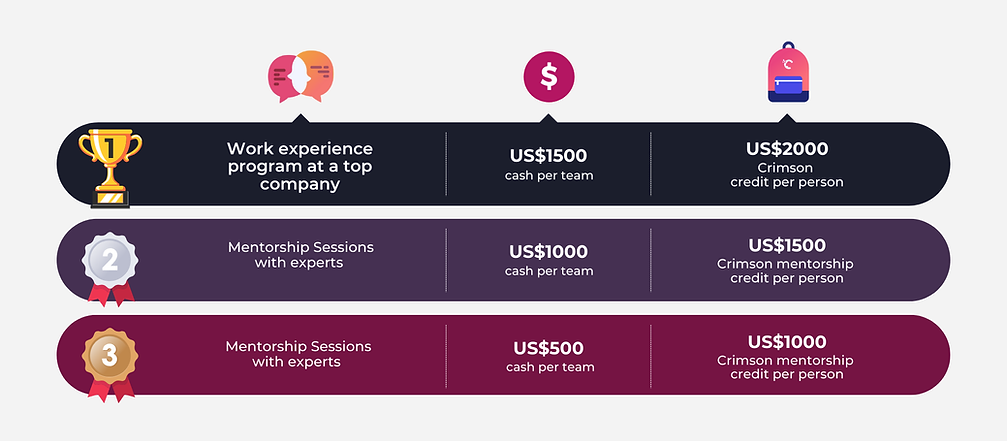
Prizes
PLEASE NOTE:
-
All students who submit their regional case will receive a Certificate of Participation once the competition ends.
-
Regional Winners will receive a Certificate of Recognition once the competition concludes.
-
Global winners will be sent a form to be filled out after the results are announced. Once this form is filled in, the HCGCC team will reach out to the winners individually to figure logistics & distribution
Deck and Presentation Criterion
**The submission forms will be sent closer to the deadlines via email.
SUBMISSION CRITERIA
Regional Qualifying
-
Teams must submit a PDF presentation for review
-
Qualifying deck submissions should consist of 5 - 8 Google Slides, excluding the title and appendix slides
-
The appendix will be attached at the end of the presentation and can not be more than 5 slides
-
Judges will review the submitted presentation based on the following criteria:
-
Issue diagnostic
-
Analysis of issues
-
Scope of innovation in recommendations
-
Metrics/validation
-
-
50 teams (5 regions with 10 teams per region) advance to next stage
More information regarding submission guidelines, judging rubric, suggested content, etc will be shared ONLY with paid participants once they register.
Regional Finals
-
Top 10 submissions from each region (50 teams overall) will be invited to the regional round
-
Regional round includes: your case solution video presentation, including your team introduction and a helicopter view of the case solution from the team
-
All team members must speak and be visible in the video
-
Judges will review the submitted videos based on the following criteria:
-
Presentation Logic
-
Engaging Speaking
-
Technical Organisation
-
Teamwork
-
-
The video must not exceed 5 minutes
-
10 teams (top 2 teams per region) advance to global finals
More information regarding pitch guidelines, judging rubric, and past examples will be shared with all paid participants once the competition starts.
Global Finals
-
For the final round, the top teams will be given a new case and they'll have to present the case LIVE to judges in a virtual event.
-
Once the Global finals are announced, the HCGCC organizing committee will prepare a detailed presentation schedule, assigning each team a specific date and time based on their respective time zones
-
The deck for this round should consist of 8 - 15 slides and present a deep dive.
-
The focus of this round is to test your understanding of the case, the depth of your analysis, and your ability to think on your feet.
-
Judges will review your pitch based on:
-
Issue diagnostics
-
Analysis
-
Scope of Innovation
-
Recommended Solution
-
Speaking Engagement
-
Teamwork
-
Q&A, etc
-
Guidelines for presentations, detailed information, judging rubric, etc will be shared with the finalists closer to the Global Finals.
DETAILS FOR EACH ROUND WILL BE SHARED WITH PAID REGISTRANTS ONCE THE COMPETITION STARTS.
Approaching The Case
It's normal to feel overwhelmed by the amount of information you learn about a new case. How do you even begin?
Overwhelmed? Simplify.
-
Perform a thorough diagnosis of the key challenges the business is experiencing
-
Propose the most efficient strategies to solve challenges
-
Explain strategy implementation and include financial projections of costs and revenues
-
Support all points with data and clarify assumptions with rationale
In the regional round, each team will have approximately 5 days to accomplish the above. Teams will need to allocate their time efficiently.
In the global round, teams will have 4 days from case release to presenting.
Efficiency is key.
Steps For Success
Step 1 : Understanding The Case
Generally, this time should not be used for discussion, except to ensure that everyone understands the case. Each team member analyzes the current state of the business and its problems. Tools such as a SWOT analysis (Strengths, Weaknesses, Opportunities, Threats) can be useful.
Step 2 : Discussion Time
Share initial thoughts and insights. Ensure that every team member understands the company's situation and challenges.
Step 3 : Discussion Of The Issue
As a team, choose 1-2 issues to address. In some cases, pressing issues can be identified immediately. In others, the business may appear to be doing fine. The first step is to choose and justify which issues should be prioritized. A market study can be necessary to determine whether growth opportunities exist or why growth is stunted. Remember to link the issues to tangible impact on the business.
Step 4 : Strategy Brainstorm
If the team has chosen more than one issue, an option is to break into smaller groups for more efficient use of time. Brainstorm as many focused, results-driven ideas for solving the problem as possible.
Step 5 : Strategy Implementation
Carefully consider the difficulty of implementation, risk, and short and long-term impacts of each strategy to narrow down which to develop. Keep the strategy concise. Judges will see right through any fluff. Consider different stages of implementation and different components that serve slightly different purposes. Put everything on a timeline in the presentation.
Step 6 : Financial Projections
Most business leaders think in financial terms, so this is the chance to prove that the monetary benefits of the proposed strategies outweigh the costs. Consider both forecasts where everything goes to plan and when market changes or other factors could take place. Although accuracy is always good, don’t get trapped into thinking every dollar must be forecasted – the uncertainty of future circumstances allows for a fair bit of creative license.
Step 7 : Putting It All Together
Most business leaders think in financial terms, so this is the chance to prove that the monetary benefits of the proposed strategies outweigh the costs. Consider both forecasts where everything goes to plan and when market changes or other factors could take place. Although accuracy is always good, don’t get trapped into thinking every dollar must be forecasted – the uncertainty of future circumstances allows for a fair bit of creative license.
Live Presentation Tips
The presentation aspect of the competition is crucial and must not be overlooked. Judges do NOT assess performance during the preparation, they only see the final product!
-
Be confident! Remember you are proposing ideas to business managers, and cannot expect them to be confident in your ideas if you cannot sell them yourself.
-
Make a good first impression and create a connection with the judges by introducing yourselves to them as you enter.
-
Simplicity is key — try and make slides visual and simple. Diagrams are usually more effective than words.
-
All team members must speak during the presentation. The most effective decks will be split evenly among members. Often, teams will work with a double speaker setup; this involves having two people speak per section and splitting up the presentation by section.
-
Ensure all team members are engaged with the presentation the entire time, even when not speaking! This often involves smiling and maintaining natural eye contact with the judges.
-
The team member speaking will be responsible for indicating “next slide”. Ensure these transitions are rehearsed for a smooth delivery.
-
Keep track of time! You will have a time warning when both 2 minutes and 30 seconds remain. You will be stopped after your allotted time is up.
Preparing In The Lead-Up To The Competition
Due to the nature of a case competition, there isn’t too much time after the case is released to develop a highly compelling strategy. However, reading business news and other business-related websites before the case is released can help further one’s understanding of how the business world works. Here are some recommended readings and research areas:
Industry reports
Industry reports are periodical publications that discuss the current state of individual industries. These reports are great to learn vocabulary and identify relevant industry-specific trends.
Some suggested publications: Bloomberg, Investopedia, Harvard Business Review, McKinsey Insights, and Seeking Alpha.
Practice strategic thinking
Start by crafting solutions for everyday life challenges. Notice something that bothers you? Pinpoint it and think of simple solutions. A creative, problem-solving mindset can be developed and perfected to the point where it comes naturally in the prep room.
Current affairs
Check the news at least twice a week, especially business news. This can be found by clicking on the business section of all major news outlets or going to Yahoo Finance to keep up to date with mergers and IPOS. Yahoo Finance also offers the option to follow the performance of individual businesses, so treat these as mock case studies and analyze their decisions.
Best of luck !
Give it everything you’ve got, and above all, enjoy it !